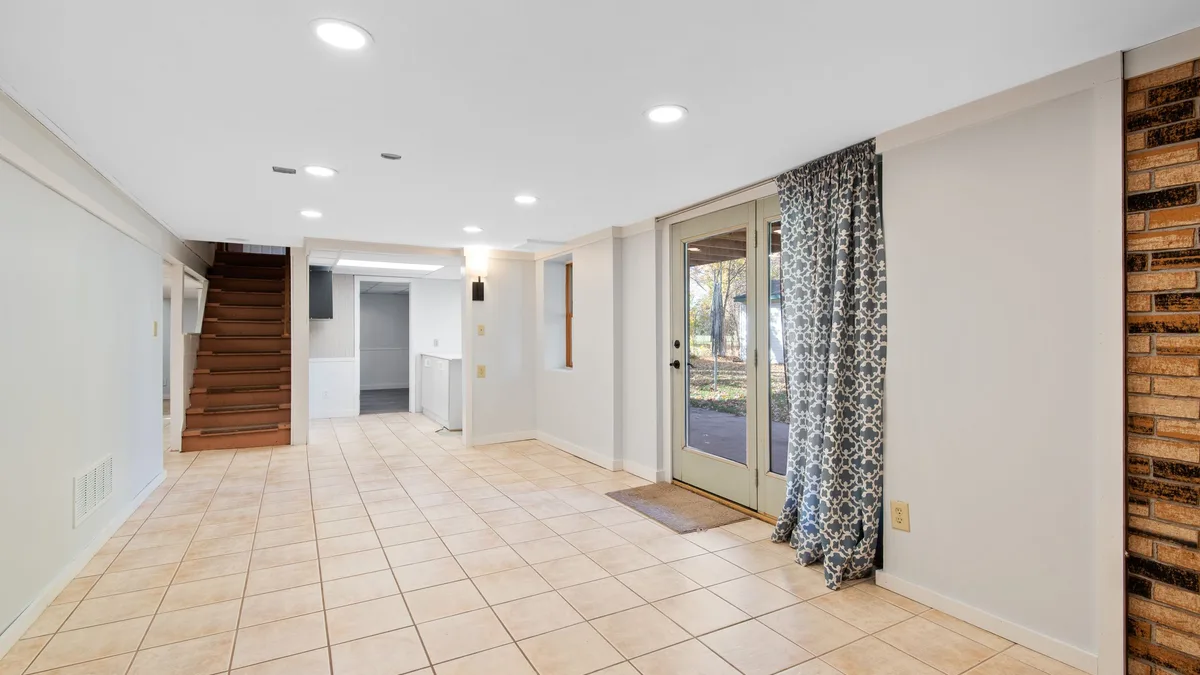
Bathrooms, laundry rooms and back entries are the three rooms in a house where water is not an accident. It is the normal condition. Somebody steps out of the tub onto the floor every day, the washer drips at the hose, and in wet weather the back door lets in whatever is on the dog and the boots.
In those rooms most people end up choosing between two floors, tile and luxury vinyl plank. Both are good answers. They are good in different ways, and the choice usually comes down to a few things about the room rather than which one is better.
Carpet and laminate first, briefly
Carpet does not belong in any of these rooms. It holds water, the pad under it holds more, and a bathroom carpet starts to smell within weeks.
Laminate is harder to rule out because it looks so much like plank, and some newer laminates are sold as water-resistant. The core is still wood-based. Water that sits at a seam or gets underneath swells it, and it does not go back down. In a dry hallway that is fine. In a room where water is a daily event, we would not put it down. LVP or laminate in a Bootheel home goes through why.
Where a wet-room floor actually fails
It is almost never in the middle of the floor. It is at the edges.
- Where the floor meets the tub or shower, and water runs off a leg and down the side
- Around the toilet, where a failing wax ring lets water into the subfloor slowly for months
- Under and behind the washer, where a supply hose weeps or a drain overflows
- At the back door, where rain blows in under the threshold
So the question for either floor is less whether the material is waterproof and more what happens to water at those junctions. That is where the two floors are genuinely different.
Vinyl plank in a bathroom or laundry room
The plank itself is waterproof. A rigid-core vinyl plank can sit in water and be unharmed. What people miss is that the floor as a whole is not sealed. A floating plank floor needs a small expansion gap at every wall, and water that reaches that gap can run underneath to the subfloor.
Done properly, that is handled. The gap at the tub and shower is sealed with a flexible sealant, as most manufacturers' instructions call for. The toilet should come out, so the plank runs underneath where it sits instead of being cut around its base, and then go back on a new wax ring. Settle who handles the toilet at the estimate. If the new floor is thicker than the old one, the flange height has to be checked so the seal is sound.
What vinyl plank does well in these rooms:
- It is warmer and softer underfoot than tile, which matters over a crawl space in January
- It goes in quickly, so the room is back in use far sooner than with tile
- It can often go over a sound, flat existing floor, which keeps the height down
- There is no grout to keep clean
- It is usually the lower-cost of the two
One thing to plan for: a floating floor should not have heavy fixed things installed on top of it, because they pin it in place and stop it moving. A built-in vanity or cabinet usually stays where it is, and the floor is fitted around it.
Tile in a bathroom or laundry room
Tile is the permanent answer. Porcelain does not care about water, grit or a dropped bottle of detergent, and a well-set tile floor will outlast everything else in the room.
The condition is the same on every tile job: what is underneath has to be rigid. Tile cannot flex, so over a wood subfloor that deflects it cracks, usually along a line you could have predicted. That is why a proper tile floor in a wood-framed house often means a cement backer board or a decoupling membrane first, and why the preparation is a large share of a tile job.
What tile does well:
- Nothing wears it, including sand from a gravel drive tracked in at the back door
- Water sitting on it does no harm to the tile itself
- It suits a floor that gets mopped hard and often, like a mudroom
- A damaged tile can be replaced on its own if spares are kept
What to plan for:
- The room is out of use for longer, because tile has to set and then be grouted
- It is cold underfoot, and colder over a crawl space
- Cement grout wants sealing in a wet room, and grout lines need cleaning
- The finished floor is usually higher, which affects the transition at the door and sometimes the toilet
Choose a floor tile with some grip. A polished tile is slippery under wet feet. A matte or textured porcelain rated for floors is much safer in a bathroom, and smaller tiles have more grout lines, which adds grip as well.
Room by room
A full bathroom used every day. Either works. Vinyl plank if warmth, speed and budget matter most. Tile if you want a floor that will never need replacing and the subfloor can be made stiff enough for it.
A half bath. Usually vinyl plank, often the same plank as the hallway outside so the floor runs through without a threshold.
A laundry room. Vinyl plank is the practical choice, and it is worth running it under where the machines sit rather than stopping at their front edge. Braided supply hoses and a drain pan under the washer do more to protect the floor than either material does.
A back entry or mudroom. This is where tile really earns its keep, because grit is the enemy of every other floor. Where tile meets a plank hallway, the height difference needs a proper transition rather than a ramp of filler, which is stairs and trim work.
Check the subfloor before you choose
In all of these rooms, the most common thing we find when the old floor comes up is a soft spot: in front of the toilet, beside the tub or under the washer. It is usually water that got through slowly over years.
It has to be cut out and replaced before either floor goes down. Tile over a soft spot cracks; plank over a soft spot dips and separates. If the floor around your toilet feels spongy, the base is stained or the toilet rocks, tell us at the estimate so it is in the plan. The subfloor decides the job explains why that matters more than the material, and in a manufactured home it matters even more, as flooring for a mobile or manufactured home covers. If the water was more than a slow drip, replacing flooring after a leak or flood covers what has to happen first.
Deciding in your own house
We bring samples to the house and put them down in the room, so you can see them in your light, next to your tub and your trim. We look at the subfloor, check the door and threshold heights, and give you a written figure with the removal, the prep and the trim as separate lines.
The estimate is free across Sikeston, New Madrid, East Prairie and the rest of the towns we cover. Book one here or call 573-471-8700.