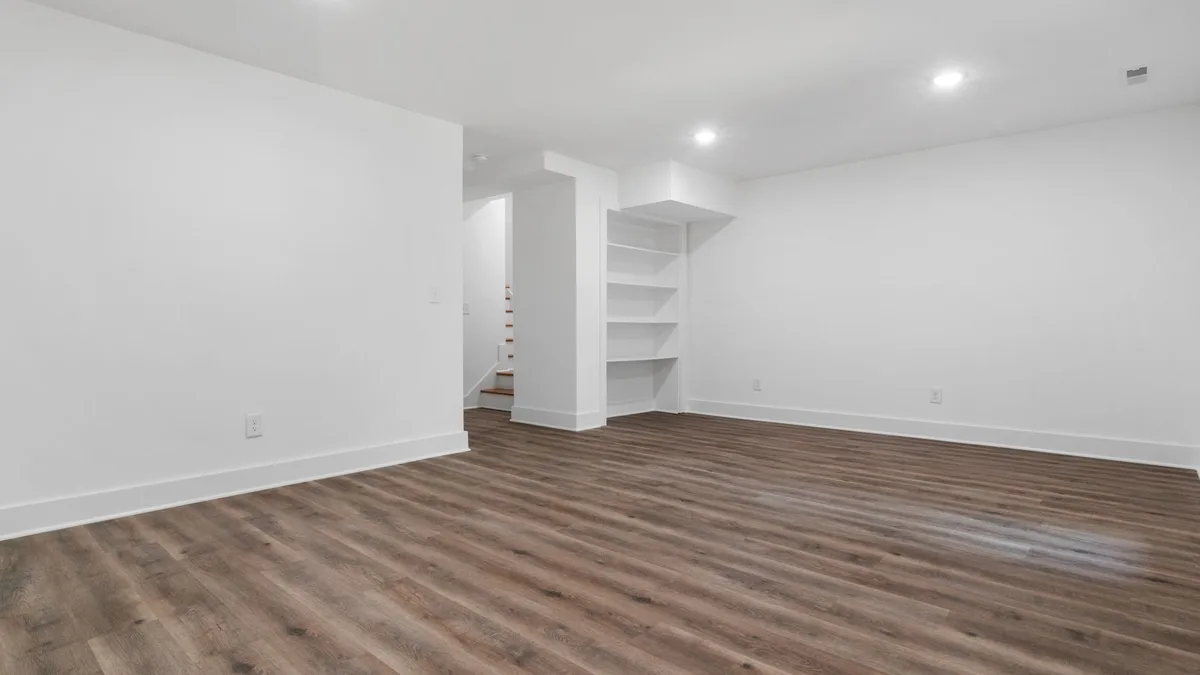
Put a luxury vinyl plank sample next to a good laminate sample and most people cannot tell which is which. Both are printed to look like wood, both click together, both come in the same fashionable oaks and grays.
Then you spill something, and they are not remotely the same product.
This comes up on nearly every estimate we do around Sikeston, so it is worth laying out properly.
What they actually are
Laminate is a wood product. The core is high-density fiberboard — compressed wood fiber — with a printed photographic layer on top and a clear wear layer over that. It is a very good imitation of wood and it is hard-wearing underfoot.
Luxury vinyl plank is a plastic product. The core is rigid PVC composite, with the same kind of printed layer and wear layer above it. It is quieter and slightly softer to walk on than laminate, and it is completely unbothered by water.
That is the whole difference, and it is a big one: one has a wood core and one does not.
What water does to each
Spill a glass on a laminate floor and wipe it up, and nothing happens. Laminate handles surface water fine.
The problem is water that sits, or water that gets underneath and into the seams. Fiberboard swells when it absorbs moisture, and it does not swell back down. What you get is a permanent raised lip along the plank edges — the trade calls it peaking — and the only fix is replacing the affected planks. If the boards have swollen, they usually will not come apart cleanly either, so the repair spreads.
LVP has nothing in it to swell. A rigid-core plank can sit in standing water and be fine when it dries. What matters underneath it is the subfloor, not the plank.
Why that matters here specifically
A few things about houses in this part of Missouri push the decision toward vinyl more often than not.
Summers are humid, and a lot of homes around here sit low with crawl spaces underneath. Moisture moving up through a slab or a crawl space is a normal condition, not an unusual one, and it is exactly the condition that finds a fiberboard core over time.
We also get storms that put water on floors. Not every year and not every house, but often enough that when somebody is choosing a floor for a whole main level, it is worth asking what happens if this room takes on an inch of water once in ten years. With laminate the answer is that you replace the floor. With LVP the answer is usually that you dry it out.
And kitchens, bathrooms and laundry rooms are where the everyday risk lives — a dishwasher that seeps, a supply line that lets go while you are at work. Those rooms are the easiest call of all.
Where laminate still wins
This is not a case against laminate. There are real reasons to choose it.
- It generally costs less for a comparable look, which matters when you are covering a whole house
- The top wear layer resists scratching well, which is worth something with dogs
- Better laminates have a more convincing surface texture than mid-range vinyl, because the embossing can be deeper
- It feels firmer and more solid underfoot, which some people prefer
In a bedroom, a hallway, a living room upstairs — rooms that are never going to see water — laminate is a perfectly sound choice and often the smarter buy. More on it on the laminate page.
How we usually split it
The pattern that comes up most often:
- Kitchens, bathrooms, laundry, mudrooms, anything on a slab or over a crawl space — luxury vinyl plank
- Bedrooms and upstairs living areas — laminate is fine, and so is carpet if you want the room warm
- A whole main level in one continuous material — LVP, because the wet rooms set the standard for the whole run
That last point is the one people miss. If you want one floor flowing through the kitchen, dining and living room without transitions, the kitchen decides the material.
If the choice is between hard surface and carpet rather than between the two planks, carpet or vinyl plank, room by room is the companion to this one.
Both need a flat subfloor
Whichever you pick, these are floating floors, and floating floors are unforgiving about what is underneath them. Dips and humps in the subfloor put the click joints under stress they were not designed for, and joints that are stressed eventually separate or click when you walk on them.
That is why we look under the existing floor during the estimate where we can, and why old floor removal and subfloor prep show up as their own line rather than being buried in the price of the plank.
If you are weighing these two up for your own house, book a free in-home estimate. We will bring both and lay them on your floor, in your light, in the actual room.