A lot of the people we meet at estimates are planning to stay in their house for a long time. Sometimes the new floor is for an older parent moving in. Sometimes it is a couple who want the house to keep working for them as they get older. Either way, the floor is one of the biggest things in a home that affects how safe it is to get around.
Here is what we look at when someone tells us safety is the priority, room by room and detail by detail. It is worth doing before it is needed, because changing floors is much easier while everyone can still move around the house comfortably.
Where falls actually start
Most trips and slips at home come from a handful of things, and most of them are about the floor:
- Changes in height, at doorways, between rooms and where one floor meets another.
- Wet hard floors, in the bathroom, at the kitchen sink and inside the back door.
- Loose rugs and mats that slide, bunch up or curl at the edges.
- Worn or loose carpet, with ripples or a loose edge on a stair.
- Poor contrast, where the edge of a step or a change in level is hard to see.
Fix those and you have done most of the work, whichever floor you choose.
Keep the floor at one level
The best thing you can do is keep the floor as close to the same height as possible from room to room. Every raised threshold is a place for a toe, a cane tip or a walker foot to catch.
That starts with what is under the new floor. Layering a new floor over an old one raises it, and the step up at the doorway grows with each layer. Can new flooring go over the old floor? explains when the old floor needs to come out. Where two floors do meet at different heights, the transition should be as low and gently sloped as the job allows. Floor transitions and doorways goes through the options.
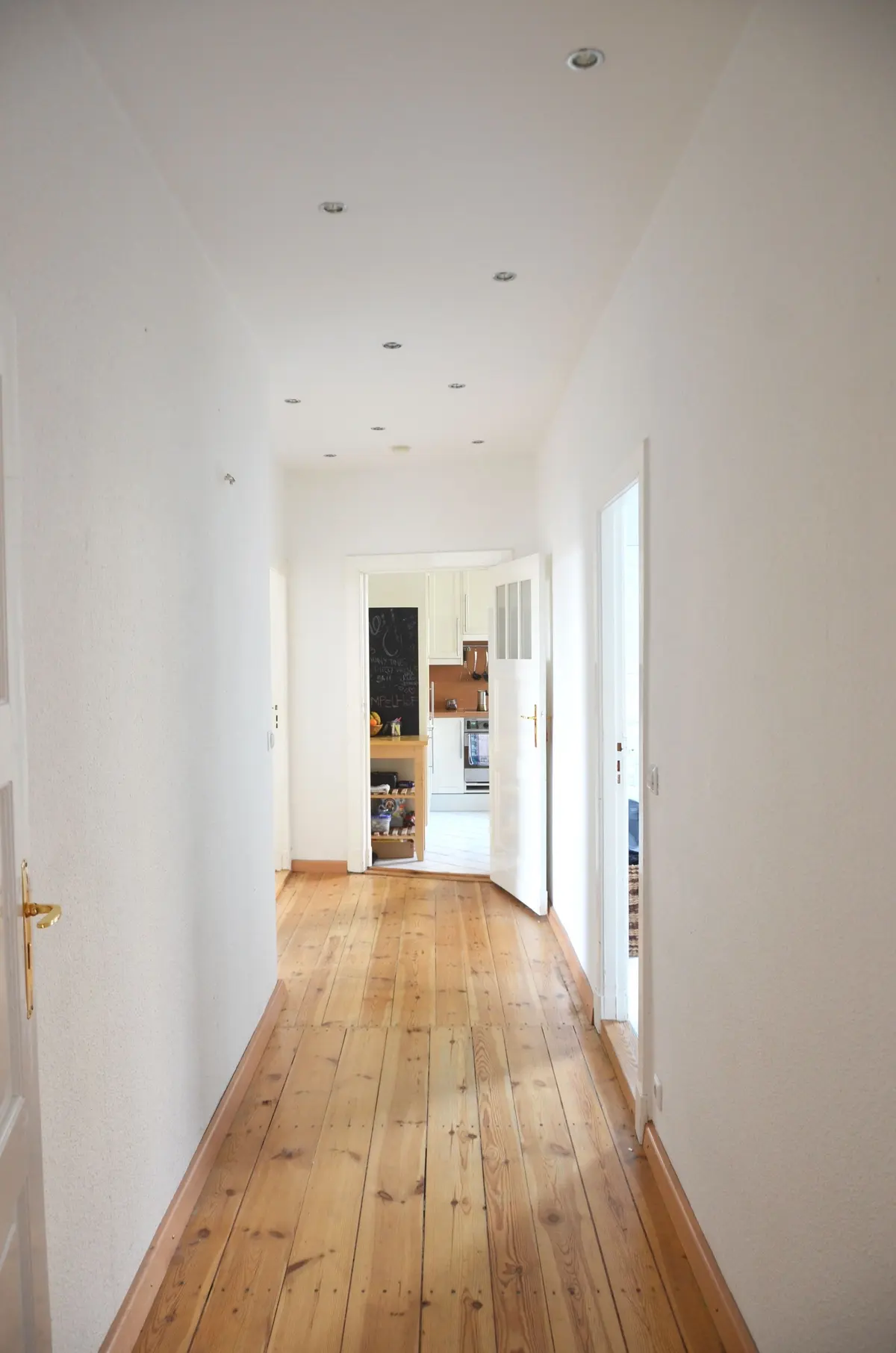
Running the same hard floor through the kitchen, hall and living areas removes several transitions at once.
Carpet: low, dense and firm
Carpet has real advantages for an older homeowner. It grips well, it is warmer underfoot, and if someone does fall, it is a softer landing than any hard floor.
The kind of carpet matters a lot, though:
- Choose a low, dense pile. A tight cut pile or a low loop gives good footing and is easy to walk or roll across. Deep plush and shag let feet sink and wheels drag.
- Use a thin, firm pad. A thick, soft pad feels comfortable but makes the floor feel unstable for anyone unsteady on their feet, and it makes walkers and wheelchairs harder to push. Carpet pad explains the difference.
- Get it stretched properly. A carpet that loosens and ripples is a trip hazard. Power-stretched carpet stays flat.
Hard floors: matte and textured
Vinyl plank is a good choice for kitchens, hallways and living areas in a house built for aging in place. It is waterproof, it rolls easily for a walker or a wheelchair, and it has a little more give than tile. Luxury vinyl plank comes in many finishes, and that is the detail to pay attention to:
- Pick a matte, textured finish over a glossy one. It gives better grip and less glare.
- Ask about slip resistance. It varies from product to product, and we can tell you what the plank you like is rated for.
- Remember any hard floor is slippery when wet. That is a reason to plan for spills, not a reason to avoid hard floors.
If a wheelchair is in the picture, choose a plank that is rated to handle rolling loads, and make sure the subfloor under it is flat and solid so the joints are not stressed. The subfloor decides the job explains why.
Bathrooms
The bathroom is where the most falls happen, so it gets the most care. Both tile and vinyl plank can work. With tile, smaller tiles with more grout lines give more grip than large, smooth ones, and the tile should be rated for wet floors. A curbless or low-threshold shower is a bigger project, but the floor should be planned with it in mind if one is coming. Tile or vinyl plank for a bathroom or laundry room covers the trade-offs.
Color and contrast
As eyesight changes, it gets harder to judge depth and see edges. A few choices help:
- Contrast between the floor and the walls so the edge of the room is easy to see.
- Avoid busy patterns and strong high-contrast designs that can make a flat floor look like it has a step in it, or hide a real one.
- Make step edges stand out. On stairs, a nosing in a contrasting color makes each edge easy to see. Stairs and trim covers stair nosings.
- Choose matte over shiny. Glare from a window across a glossy floor can hide what is on it.
Rugs and stairs
Small loose rugs are best taken up. A rug that stays should lie flat, have a non-slip backing or a rug pad, and be large enough that furniture holds it in place.
On stairs, the carpet should be tight over each nose with no loose edges, or a hard surface with firm, secure nosings. Handrails on both sides are worth adding while the work is being done. Carpet or vinyl plank on the stairs compares the two.
Tell us at the estimate
If someone in the house uses a cane, a walker or a wheelchair, or is unsteady on their feet, tell us when we come out. We plan the floor heights, transitions and materials around it. At a free in-home estimate we bring samples you can stand on and roll across in your own house, measure the rooms, and give you a written price. Book one here or call 573-471-8700. We are on Virginia Street in Sikeston and work across the area, including Matthews, East Prairie and Cape Girardeau.